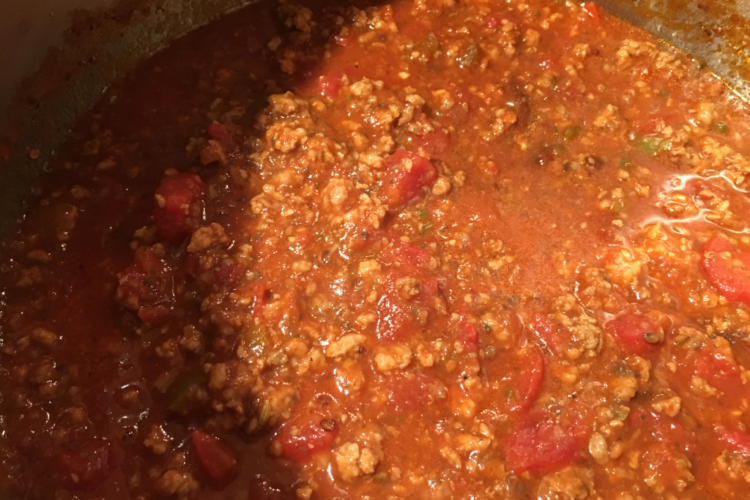
Overview:
This was my very first personally created chili recipe. I worked on refining this for roughly 10 years from around 1992 through 2002. The recipe you’ll find below is the version I settled on, for this version at least. I continued to make this version for years since 2002, but it changed every time I made it. It was never the same twice. I’ve been working on Version 2 that I hope to have buttoned up before the end of summer. The name comes from a combination of things. Pit Pirate is a really great friend, Mike Hedrick who I met online somewhere around 1996 when I got my first PC. He was (still is in my opinion) a Pitmaster based in Woodbridge VA. He had an award-winning competition BBQ team of which I was an “honorary” member. I didn’t live in VA at the time until around summer of 2011 where I ended up living less than a mile from him, so until I moved there, I couldn’t really participate in the physical team. I was blessed to have participated in a local competition with him finally around 2014.
The reason I bring up Mike is because he’s the one that gave it it’s final name. The name is simple once you know the story. Pit Pirate was simply the name of the competition BBQ team. And my chili recipe once won a 3rd place in a chili cookoff when I lived in Pennsylvania at the time and he thought it was worthy of being added. We actually cooked this together once in 2009. ATNO was an acronym for my original social media moniker I went by back in the mid to late 90’s and early 2000s. That was A True Night Owl. Atomic was added because in the early days of making it, it was considered very “hot” by a lot of folks.
Brief History of American Chili:
I saw an article earlier today that I think really says it best: “To write about chili is to court controversy; few subjects in American culinary life are so contentious. Chili is for Americans what paella is for Spaniards, or Bolognese is for Italians. It seems like everyone knows exactly what they think chili should be, and everyone knows that everyone else is wrong.” Credit: Serious Eats – Divided States of Chili: A Guide to America’s Most Contentious Stew.
The story of American chili—properly known as chili con carne (chili with meat)—is a fascinating journey. It transformed from a rough-and-tumble frontier survival ration into a major culinary phenomenon, sparking fierce regional debates over what truly belongs in the bowl.
Frontier Brick Chili
Mid-1800s
Before it was served in bowls, chili was an early form of instant food. Texas trail drivers and cowboys needed lightweight, non-perishable rations. They pounded dried beef, suet (fat), dried chili peppers, and salt into dense bricks. On the trail, they would break off a chunk, boil it in water, and have an instant, spicy stew.
The Reign of the Chili Queens
1860s–1880s
Chili moved from the wilderness into the city streets of San Antonio, Texas. Mexican-American women known as “Chili Queens” set up makeshift open-air night markets in the city squares. They cooked massive pots of chili over open fires, serving cheap, intensely flavorful stews to soldiers, tourists, and locals alike at communal tables. This popularized the dish as a commercial food.
The World’s Fair Introduction
1893
Chili went truly national at the World’s Columbian Exposition in Chicago. The “San Antonio Chili Stand” introduced the dish to millions of visitors from across the country. People fell in love with the unique heat, and visitors went home trying to replicate the recipe, cementing chili’s place in the broader American culinary lexicon.
The Great Depression and the Parlor Boom
1920s–1930s
During the economic hardships of the 1930s, “Chili Parlors” popped up across every corner of America. Chili was a savior because it was incredibly cheap to make, utilized less-desirable cuts of meat, and could be stretched further by adding beans or crackers. During this era, regional variations exploded—including Cincinnati chili (flavored with cinnamon and cocoa, served over spaghetti) and Midwest style (which frequently incorporated beans and macaroni).
The Great Cook-Off and Icon Status
1967
The legendary feud between Texas humorist Frank X. Tolbert and New York food writer H. Allen Smith over whether beans belonged in chili led to the first World Championship Chili Cookoff in the ghost town of Terlingua, Texas. It ended in a tie, but it launched an era of competitive chili cooking that persists today. In 1977, Texas officially proclaimed chili as its state dish.
ICS / International Chili Society Categories and Rules
Back in the days when I was crafting this recipe the International Chili Society only had two categories of chili that were judged by official ICS judges – Traditional red and Verde (green). There was also a People’s Choice chili that was jugged obviously by the people. Traditional red and Verde were not allowed to have any beans or fillers such as rice and pasta (in fact they still aren’t allowed). If they did that would have been considered People’s Choice and voted on by the public and not official judges. Also, back then you could only use beef, pork or chicken, if memory serves correctly. This recipe would now be considered a Homestyle Chili.
Since then that all appears to have changed. It now appears that there are four categories officially judged and still a People’s Choice category. It also appears that you can use “any kind of meat, or combinations of meat”. I’m taking that to mean that I could use any game meat like Bison, Venison, Lamb, etc..
Here are the current categories and rules:
- ICS-SANCTIONED COOKING CATEGORIES FOR ADULTS AND YOUTHS
Traditional Red Chili is any kind of meat, or combination of meats, cooked with red chili peppers, various spices and other ingredients. Beans and non-vegetable fillers such as rice and pasta are not allowed. Preference is not given to either cut meat, ground meat, shredded meat or cubed meat.
Homestyle Chili is any kind of meat, or combination of meats, and/or vegetables cooked with beans, chili peppers, various spices and other ingredients. Homestyle chili may be any color. Beans are required. Preference is not given to either cut, ground, shredded or cubed meat. Seafood is allowed.
Chili Verde is any kind of meat, or combination of meats, cooked with green chili peppers, various spices and other ingredients. Beans and non-vegetable fillers such as rice and pasta are not allowed. Preference is not given to either cut meat, ground meat, shredded meat or cubed meat.
Salsa While no set of ingredients is required for the preparation of salsa, it should contain chiles. Other vegetable, fruit, spice and herb ingredients may be added at the cook’s discretion. Salsa MUST be homemade by the contestant. Commercial salsa will not be accepted. Salsa may be prepared ahead of time or on site.
Note: The above category winners are all chosen by judges. Garnishes must not be used for any category. Rule of thumb- if an ingredient found on the top layer of an entry bowl cannot also be found mixed throughout the entire bowl, it is a garnish and is not permitted. If a bowl is delivered for judging with a garnish, the bowl will be disqualified
People’s Choice Chili (PC) Any type of chili may be served as PC chili. Winners are determined by the public. PC is required by all adult contestants.
Please see the ICS website for more information and a complete list of the rules. ICS Chili, Inc.
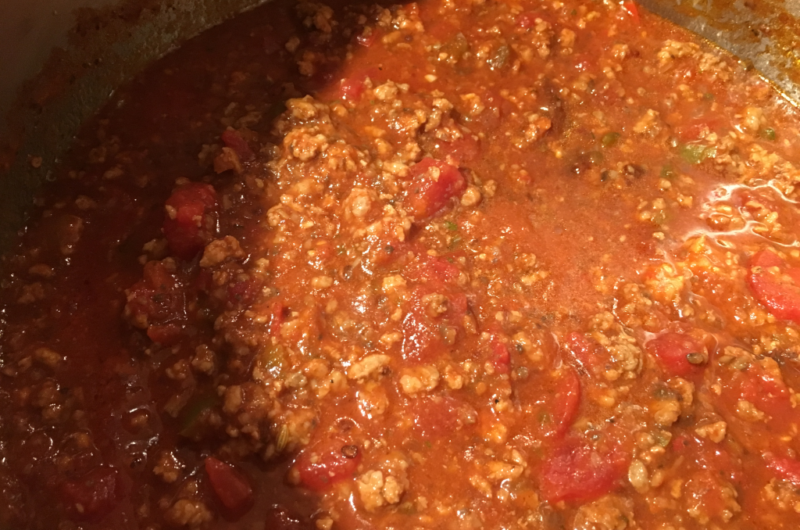
Pit Pirate Atomic ATNO Chili
Course: Main Course, EntreeCuisine: American, Tex-MexDifficulty: Beginner-Friendly12
servings45
minutes3
hours300
kcal3
hours45
minutesMain Ingredients
1/2 large Vidalia onion diced (full onion if you like onions)
4-6 garlic cloves minced
2 29 oz. cans Hunts Tomato Sauce
16 oz Pace Picante Sauce Hot
1 40 oz. can Hanover Redskin Light Red Kidney Beans (or equivalent smaller cans)
1 15oz can Bush’s black beans – seasoned recipe
8 oz sliced mushrooms
3 large ripe tomatoes sliced and diced to medium size chunks
4 green jalapeno peppers diced (include seeds for hotter chili)
4 green cayenne chili peppers diced (include seeds for hotter chili)
2 lbs ground beef
3 tablespoons tapioca
- Spice Ingredients
1 Tbs black pepper
1 Tbs onion powder
1 Tbs Course Ground Garlic Salt with Parsley
1 Tbs Cayenne powder
6-8 Tbs Chile Powder
2 Tbs Cholula Hot sauce (Original)
2 Tbs Lea & Perrin’s Worcestershire Sauce
(use spice seasonings at your own discretion)
Directions
- In large stock pot, brown ground beef. Halfway through browning add black pepper, onion powder, garlic salt with parsley, minced garlic.
- While browning beef — sauté onions, and fresh jalapeños and cayenne chili peppers in fresh extra virgin olive oil -when onions have caramelized color add mushrooms and continue to sauté until mushrooms are browned. Combine with beef until continue cooking until beef is fully browned.
- Blanch diced tomatoes in same pot.
- Add and stir in Pace Picante Sauce and both cans of tomato sauce.
- Strain liquid from the beans and add to pot and add tapioca (thickener and sweetener).
- Add all spice ingredients to pot. Add salt to taste (this recipe is naturally salty due to the canned ingredients so always taste before adding salt)
- Bring to a boil, reduce to simmer, cover and cook for 3 hours stirring occasionally to avoid sticking to the bottom of the pan.
Notes
- This is a spicy chili to some, but not the spiciest chili I’ve ever made. The tapioca serves as a thickener but also a sweetener to an extent. You can also lower the heat level by not including the seeds or ribs of the peppers. This tastes better reheated the next day.
- Nutrition information is approximate.
The “Vitamin Superstars” in this recipe
The B12 Powerhouse (66% DV): Because Vitamin B12 is found almost exclusively in animal products, the two pounds of ground beef do the heavy lifting here. B12 is essential for nerve function and red blood cell production.
The Antioxidant Duo (Vitamins A & C): This recipe hits over a third of your daily needs for both. The massive amount of chili powder (6–8 tablespoons) combined with the tomato bases yields a ton of Vitamin A (as beta-carotene). Meanwhile, packing 10 whole hot peppers plus 3 fresh tomatoes into the pot ensures you get a great dose of heat-stable Vitamin C.
Energy and Cellular Support (B6 & Folate): The beans supply a solid baseline of Folate, which helps your body make DNA and divide cells, while the beef and aromatic veggies supply B6, which is crucial for brain development and keeping your nervous and immune systems firing properly. - This is not Vegan, Vegetarian or Gluten Free
Nutrition Facts
12 servings per container
Serving Size1.5 cups
- Amount Per ServingCalories401
- % Daily Value *
- Total Fat
21.1g
28%
- Saturated Fat 4.7g 24%
- Trans Fat 0g
- Cholesterol 0mg 0%
- Sodium 2040mg 89%
- Total Carbohydrate
48.6g
18%
- Dietary Fiber 11.2g 40%
- Total Sugars 26.3g
- Protein 26.3g 53%
- Vitamin A 340mcg 38%
- Vitamin C 32mg 36%
- Vitamin E 2.1mg 15%
- Vitamin K 12mcg 10%
- Vitamin B6 0.4mg 24%
- Vitamin B12 1.6mcg 67%
- Folate 70mcg 18%
* The % Daily Value tells you how much a nutrient in a serving of food contributes to a daily diet. 2,000 calories a day is used for general nutrition advice.